Solar support in Pakistan now comes in five distinct forms, and this hub keeps them separate so you can find your route in one pass: the CM Punjab Free Solar Panel Scheme gives free systems to low-unit Punjab homes, the Sindh Solar Home System puts a low-cost solar kit into off-grid Sindh households, the Balochistan Solar Tube Wells project converts listed farm tube wells to solar for free, the PM Electric Bike Scheme (PAVE) subsidises electric bikes and rickshaws nationwide with interest-free loans, and SBP Solar Financing lends at a capped 6% for rooftop systems the free schemes do not reach. Below: the comparison table, a short guide to each scheme, the truth about electricity bill relief, and how to route yourself.
Solar and Energy Schemes at a Glance
| Scheme | What it gives | Who it serves |
|---|---|---|
| CM Punjab Free Solar Panel Scheme | Free solar systems for 0 to 200 unit homes; installations under way, registration closed | Punjab households with low monthly electricity use |
| Sindh Solar Home System | A solar home kit for about Rs 7,000 | Off-grid and low-access households in Sindh |
| Balochistan Solar Tube Wells | Free conversion of listed farm tube wells to solar power | Balochistan farmers on the project lists |
| PM Electric Bike Scheme (PAVE) | Subsidy plus interest-free loans for electric bikes and rickshaws | Buyers across Pakistan |
| SBP Solar Financing | Bank loans at a markup capped at 6% for systems up to 1 MW | Homes, farms and businesses buying their own solar |
CM Punjab Free Solar Panel Scheme: Free Solar for Low-Unit Homes
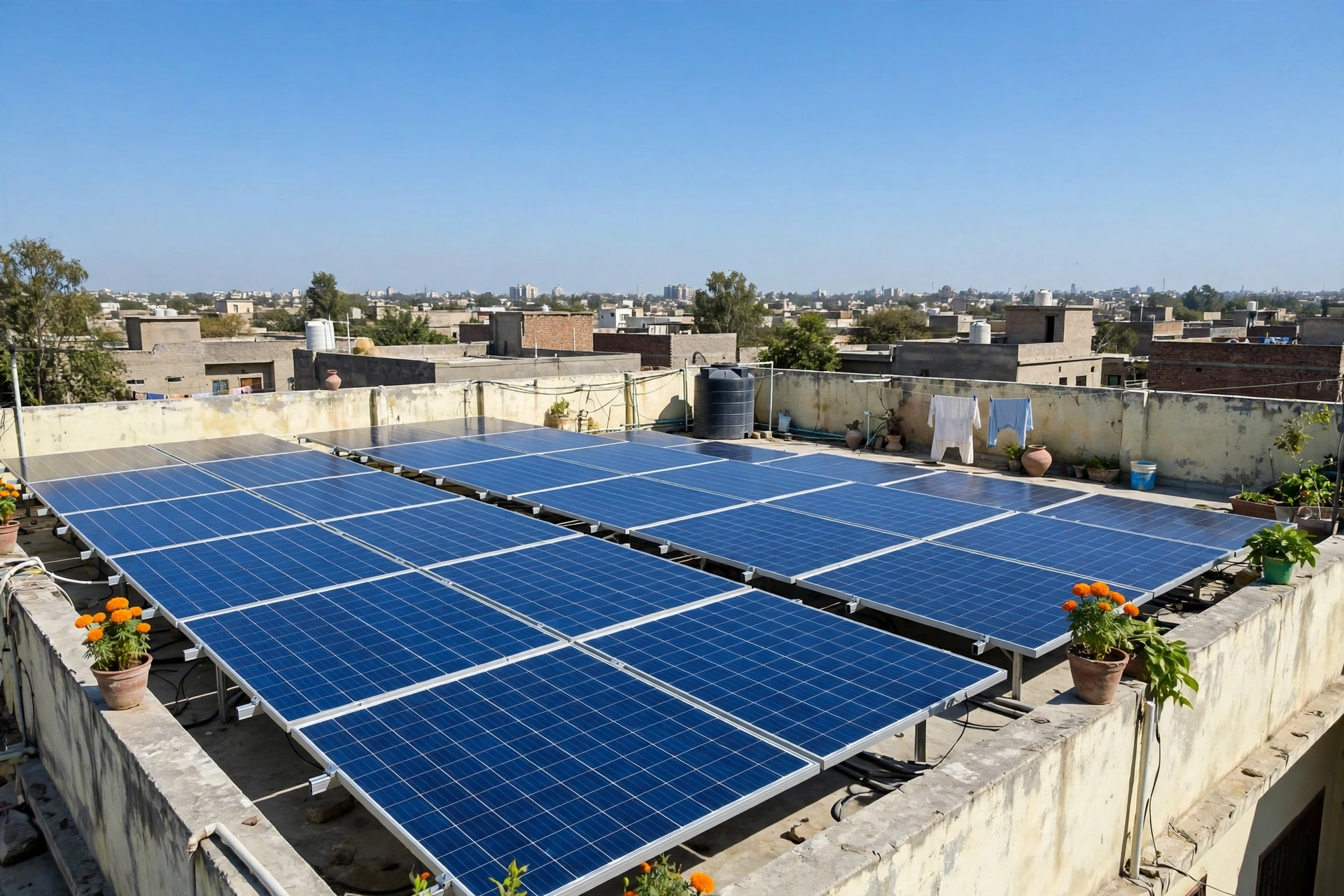
Punjab’s free solar scheme is aimed at the smallest electricity consumers: households using 0 to 200 units a month, whose bills are small but still painful. The province installs complete systems for these homes at no cost to the family, and installations are under way. The honest status point matters here: registration for the scheme is closed, so anyone collecting forms or fees for a “new round” is not speaking for the government. Our full guide explains the eligibility logic, what selected households receive and how to treat claims of fresh registration when they circulate.
Sindh Solar Home System: A Solar Kit for Off-Grid Households
Sindh’s answer is built for a different problem: homes the grid barely reaches. The Sindh Solar Home System provides a basic solar kit, covering essentials such as light and a fan, for a household contribution of about Rs 7,000, with the project carrying the rest of the cost. It is deliberately modest equipment, sized for off-grid and low-access households rather than full-house supply, and it reaches families through the project’s own distribution process rather than an open market sale. Our guide sets out what the kit contains, who it is meant for and how distribution works in practice.
Balochistan Solar Tube Wells: Free Solarization for Farmers
In Balochistan the solar priority is water. Grid electricity for agricultural tube wells has been unreliable and heavily subsidised for years, so the federal and provincial governments are converting listed farm tube wells to solar power at no cost to the farmer. The key word is listed: the project works through identified tube wells rather than open applications, and conversion removes the farmer’s dependence on a few hours of grid supply. Our guide explains how the lists and district rollout work, what a converted farmer receives, and what to do if your tube well is not yet on the list.
PM Electric Bike Scheme (PAVE): Subsidy and Interest-Free Loans
The energy problem is not only in the home; it is also at the petrol pump. The PM Electric Bike Scheme, run under the PAVE programme, supports buyers of electric bikes and rickshaws across Pakistan with a government subsidy combined with interest-free loans, cutting both the purchase price and the running cost of daily travel. Unlike the provincial free schemes, this is a nationwide offer with a financing structure, so eligibility, approved models and the application route all matter. Our guide walks through the subsidy and loan design, who can apply and how the process runs from application to delivery.
SBP Solar Financing: 6 Percent Loans for Your Own Rooftop
Households above the free schemes’ unit limits, and businesses of every size, still have a subsidised route: the State Bank of Pakistan’s renewable energy financing, under which banks lend for systems up to 1 MW at an end-user markup capped at 6% a year. Add net metering and the system can sell its surplus back to your DISCO, shortening its payback every sunny month. The trap to avoid is a bank’s ordinary retail solar product being sold at a different rate under a similar name. Our guide breaks down the categories, the rate build-up and the written question to ask before signing.
Electricity Bill Relief and Energy Assistance in Pakistan
There is no standing cash scheme that pays household electricity bills, and this page will not pretend otherwise. The support that exists today is structural: the protected-consumer tariff structure, which keeps the per-unit price lower for small consumers than for larger ones. The two big relief packages readers still ask about are both finished: Punjab’s per-unit bill relief ran in August and September 2024, and the federal Bijli Sahulat winter package, which discounted extra winter consumption, ran from November 2024 to February 2025. Neither is open for registration now. Anyone selling “bill relief registration”, by phone, form or social media, is running a scam; genuine relief arrives automatically on the bill or not at all.
Government Solar Projects: Public Buildings Going Solar
Government is also a solar customer in its own right. The Sindh solar project includes about 20 MW of rooftop solar on government buildings, and federal and provincial governments are solarising offices, schools and hospitals to cut official electricity bills and keep essential services running through load shedding. Balochistan has announced off-grid solar stations for areas that have no grid stations at all, taking solar to settlements the transmission network never reached. These projects do not take household applications, but they explain where much of the public solar money goes, and they are the backdrop against which the household schemes above operate.
Which Solar Scheme Fits You?
Route yourself by situation. A Punjab home using 0 to 200 units a month belongs to the free solar story: read the Punjab guide, note that registration is closed, and wait only for official announcements. An off-grid Sindh household should look at the Sindh Solar Home System. A Balochistan farmer should check the tube well project lists through our Balochistan guide. A commuter anywhere in Pakistan pricing an electric bike or rickshaw starts with PAVE. And any home, farm or business ready to buy its own rooftop system, at any consumption level, should price the SBP 6% loan and net metering before paying a commercial rate.
Solar and Energy Schemes FAQs
The routes a new applicant can still act on are the SBP solar financing window at banks, which is a standing facility, and the PM Electric Bike Scheme (PAVE) on its announced application rounds. Punjab’s free solar registration is closed while installations continue, and the Sindh and Balochistan projects work through their own lists and distribution rather than open registration.
Punjab ran a free solar panel scheme for homes using 0 to 200 units (registration closed, installations under way). Sindh provides heavily subsidised solar home kits to off-grid households for about Rs 7,000 rather than fully free. Balochistan’s free solar effort targets farm tube wells, not homes. Other households use SBP financing at 6%.
Yes, through the State Bank of Pakistan’s Financing Scheme for Renewable Energy, where Category II loans for systems up to 1 MW carry an end-user markup capped at 6% a year. Ask your bank in writing whether your loan is booked under this scheme, because banks’ own retail solar products can carry different, KIBOR-linked rates.
The PM Electric Bike Scheme (PAVE) combines a government subsidy with interest-free loans for electric bikes and rickshaws, and it operates nationwide rather than in one province. Approved models, quotas and application rounds are announced through the programme; our PAVE guide tracks the structure and the route to apply.
No open bill relief scheme is taking registrations. Standing support is the protected-consumer tariff for small users. Punjab’s per-unit relief of August to September 2024 and the federal Bijli Sahulat winter package of November 2024 to February 2025 have both ended.
Never pay an agent for registration in any scheme on this page: genuine schemes are free to join, work through official portals, DISCOs, banks or project lists, and announce rounds through government channels. Treat social media forms, WhatsApp registration links and anyone demanding a processing fee as fraud, and verify a scheme’s status on its official page before sharing your CNIC.
Last updated: November 4, 2026