
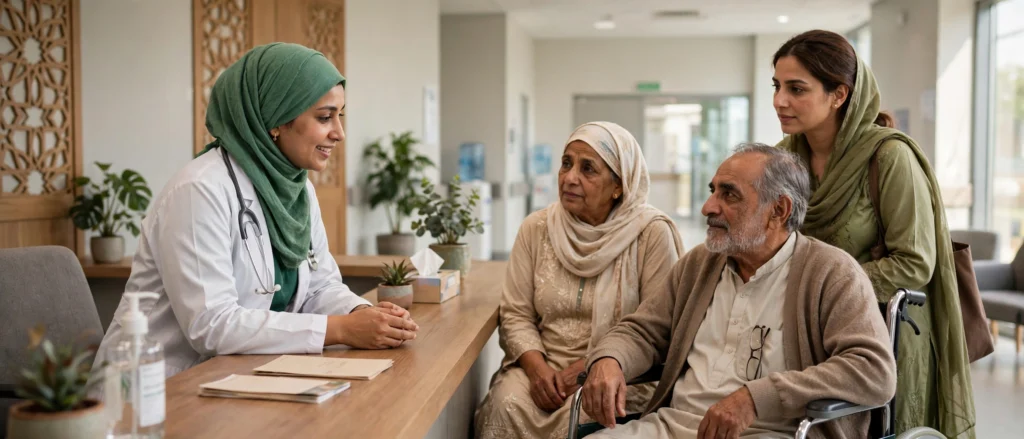
The Sehat Sahulat Program is the government’s health insurance scheme for low-income families. If your family is registered in the NSER survey and qualifies, your hospital treatment at empanelled public and private hospitals is paid by the programme, up to Rs 1 million per family per year, instead of coming out of your pocket. This page explains what is covered, how to check your eligibility in one SMS, and how to actually use the card at a hospital. For the full list of health and other programmes, see all current schemes on our homepage.
| Fact | Detail |
|---|---|
| Scheme | Sehat Sahulat Program (health card) |
| Cover | Free hospital treatment up to Rs 1 million per family per year |
| Eligibility | Low-income families recorded in the NSER survey |
| Check eligibility | SMS your CNIC number to 8500 |
| Your card | In most cases your CNIC itself works as your health card at empanelled hospitals |
| Where | Empanelled public and private hospitals across Pakistan |
What Does Sehat Sahulat Cover?
The programme pays for treatment that needs admission to a hospital. That includes surgeries, emergency care, maternity care, and treatment for major illnesses at hospitals on the programme’s panel. Care is cashless within your yearly cover: the hospital bills the programme, not you.
Day-to-day clinic visits (OPD) and medicines bought outside an admission are generally not covered, and treatment above the yearly limit of Rs 1 million per family is not paid by the programme. If a hospital asks you to pay for covered treatment, ask for the programme’s help desk in that hospital before paying.
How to Check Your Sehat Sahulat Eligibility
- Open your messaging app.
- Type your 13-digit CNIC number.
- Send it to 8500.
- The reply tells you whether your family is covered.
You can also confirm at the sehat desk of any empanelled hospital, where staff check the same record. If the reply says you are not covered, the usual reason is that your household is not in the NSER survey or its record is outdated. The fix is the free NSER survey described on our BISP page.
How to Get Treatment on Sehat Sahulat
- Choose a hospital on the programme’s panel. The official programme website lists empanelled hospitals, and large hospitals display the programme’s signage.
- Go to the hospital’s sehat or facilitation desk with the patient’s CNIC before admission.
- The desk verifies your cover in the system and processes the approval.
- Treatment proceeds, and the bill within your cover is settled by the programme.
Keep your CNIC valid and with you. For children, the family’s record and B-Form details are used at the desk.
What to Do in an Emergency
In an emergency, go straight to the emergency department of the nearest empanelled hospital and take the patient’s CNIC with you. Emergency treatment should not wait for paperwork: inform the hospital’s sehat facilitation desk as soon as you arrive, and the desk processes the cover approval with the admission. If the first hospital cannot treat the patient, its desk can guide you to another empanelled hospital that can.
Sehat Sahulat or Sehat Card Plus?
Khyber Pakhtunkhwa runs its health cover under its own name, Sehat Card Plus, with its own arrangements and hospital panel. If you live in KPK, your treatment works through that programme rather than the federal Sehat Sahulat arrangements described on this page, although the idea is the same: eligible families get cashless hospital treatment within a yearly limit. Residents of other provinces and regions should follow the 8500 SMS check described above and the guidance of their hospital’s sehat desk.
Who Qualifies, and Who Does Not
Eligibility follows the NSER record, the same national survey behind BISP cash assistance. Families whose survey shows low income are covered; families above the survey’s thresholds are not, even if they hold other government cards. Coverage is per family, not per person, and the Rs 1 million limit renews each year. Serving arrangements can differ slightly by province, so the hospital desk’s check on the day is the final word for your case.
Sehat Sahulat Program: FAQs
Send your 13-digit CNIC number by SMS to 8500. The reply confirms whether your family is covered. You can also ask at the sehat desk of any empanelled hospital.
In most cases, no. Your CNIC itself serves as your health card, because your eligibility is stored in the system against your CNIC number. Take your CNIC to the hospital’s sehat desk.
Empanelled public and private hospitals across Pakistan. The official programme website carries the hospital list, and empanelled hospitals show programme signage and run a sehat facilitation desk.
Generally, no. The programme covers treatment that requires hospital admission, within the yearly limit of Rs 1 million per family. Routine OPD visits and medicines outside an admission are not covered.
It usually means your household is missing from the NSER survey or the record is old. Complete or update the free NSER survey at your BISP tehsil office, then check again by SMS to 8500.
Yes, for covered treatment within your yearly limit at an empanelled hospital. The hospital bills the programme directly. If anyone demands payment for covered care, raise it at the hospital’s programme help desk.
Before you go to hospital, keep your CNIC, your family record details, and any previous treatment papers together in one folder, so the sehat desk can check your cover quickly. If you change your address or mobile number, update your record at the BISP tehsil office, because an old address or number can delay verification. If a hospital says your cover is not found, do not pay first and argue later: ask for the sehat desk, note the name of the person you spoke to, and check again by SMS to 8500 after your record is updated. Share this page with family members so they also know the SMS check and the hospital desk process.
Keep exploring: Health Schemes · Federal Schemes · All Government Schemes
Last updated: November 4, 2026