The Sindh Solar Home System puts a basic solar kit into homes that have little or no grid electricity, for a one-time household payment of about Rs 7,000, with about 80 percent of the cost carried by the government side. There is no open public application portal for this scheme: kits are distributed district by district through partner organisations working from district lists. This guide sits inside our Solar and Energy Schemes hub and our Sindh Schemes collection, and it explains what the kit contains, which households receive it, how distribution actually reaches a village or neighbourhood, and where distribution has reached so far.
The scheme is the household component of the Sindh Solar Energy Project (SSEP), run by the Sindh Energy Department with support from a World Bank project of $105 million, of which $100 million comes from the World Bank, agreed in 2019. The wider project is bigger than home kits: it also includes solar parks and rooftop solar on government buildings. The Solar Home Systems component is the part that reaches ordinary families, and it targets 200,000 households across 30 districts of Sindh, generally those using under 100 units of electricity a month or living with weak or no grid access.
| Item | Detail |
|---|---|
| Scheme | Sindh Solar Home System (part of the Sindh Solar Energy Project) |
| Run by | Sindh Energy Department, with World Bank project support |
| Target | 200,000 households in 30 districts |
| Who it is for | Households with low or no grid access, generally under 100 units a month |
| Kit price to the household | About Rs 7,000, one time |
| Cost share | About 80 percent borne by the government side |
| Kit | 80W panel, battery, three LED bulbs, DC pedestal fan, mobile charging |
| How to get it | District by district distribution; no open application portal |
Sindh Solar Home System Eligibility: Who Receives the Kit
The target household is one the grid barely serves. The component was designed for families with low or no access to electricity, generally consuming under 100 units a month, spread across 30 districts of Sindh. These are homes where the evening problem is basic: light for children to study, a fan in the heat, and a way to charge a phone without paying a shopkeeper.
Eligibility is therefore not something a household proves with documents at an office. The project works through district lists prepared for the distribution programme, so a family’s presence in its district’s target area and consumption profile is what matters. If your home uses well over 100 units a month on a strong grid connection, this kit was not designed for you, and larger rooftop options, including financed systems, fit better.
What Is Inside the Sindh Solar Home System Kit
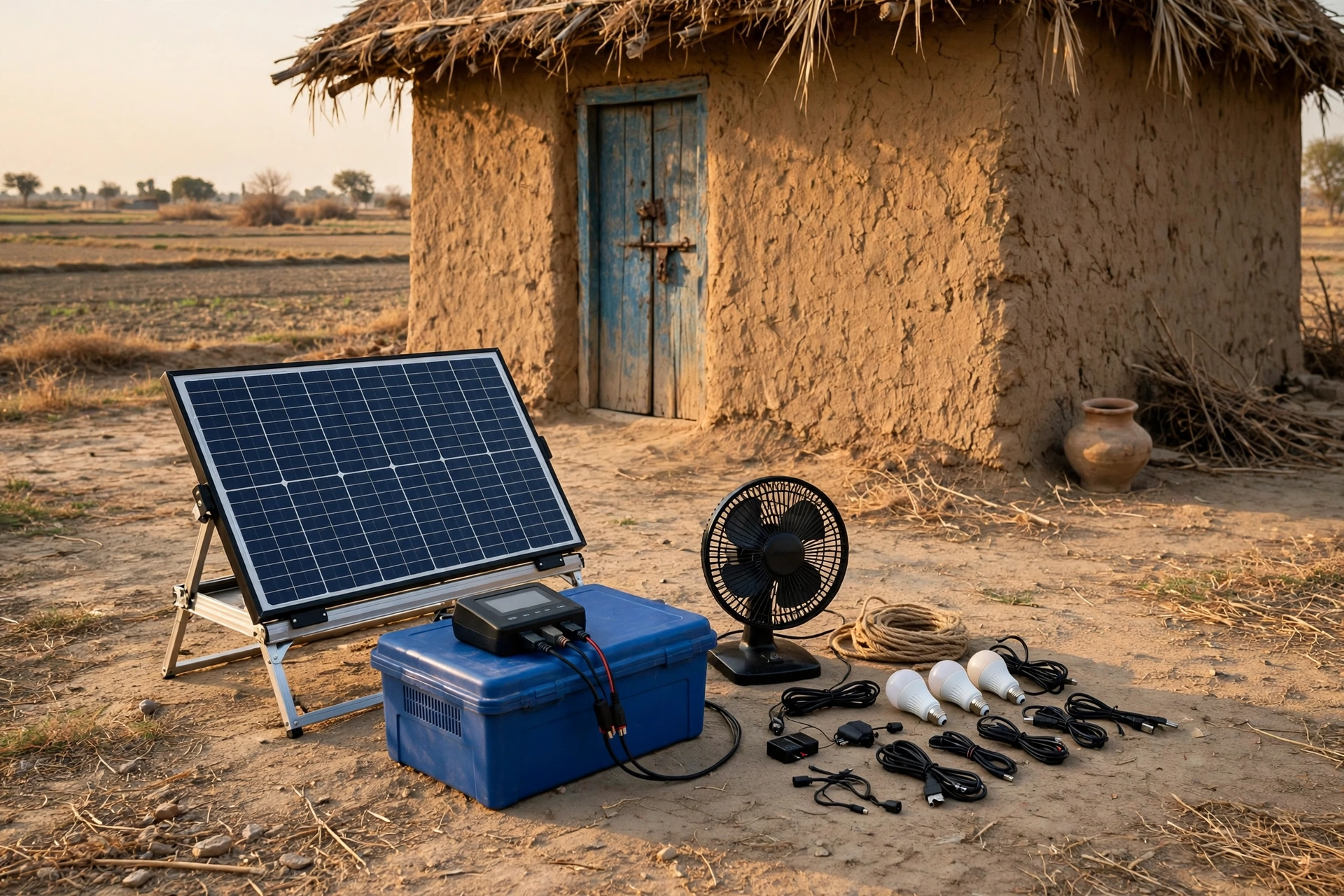
The kit is a small off-grid package built for essentials, not a whole-house solar system. It contains an 80W solar panel, a mounting frame, a charge controller, an 18Ah lithium battery, three LED bulbs, a metal DC pedestal fan and a mobile charging facility. Everything runs on the DC side, which is why the fan is a DC fan and the lights are LED: the design squeezes the most use out of a small panel and a modest battery.
Set expectations correctly. This kit will light rooms, run the pedestal fan and charge phones through the evening. It will not run a fridge, an air conditioner, a washing machine or an iron. For a home that previously had no dependable electricity at all, though, lights, a fan and phone charging change daily life in a way that is hard to overstate.
On price, the household pays about Rs 7,000 once. That payment exists because about 80 percent of the cost is borne by the government side under the project, and the household contributes the remaining share. The Rs 7,000 figure is the official household share; it is not a starting point for negotiation, and no distributor is authorised to charge more on top of it.
How the Sindh Solar Kit Is Distributed
Distribution is carried out by partner organisations, district by district, rather than through a public counter or website. HANDS Foundation, for example, is a last-mile distributor responsible for 86,667 systems across 13 districts, which shows the scale at which partners operate: they receive the kits, work through the district lists and install at household level.
Because there is no open application portal, the honest answer to “how do I apply” is that individual households do not apply online. Households are reached when distribution comes to their district and their household is on the programme’s list for that area. Enquiries belong at the district level and through the distributing partner working in your area. Anyone advertising paid registration for the Sindh Solar Home System is describing a process that does not exist, and money handed over on that promise should be treated as lost.
Sindh Solar Home System Distribution Status
Distribution is well advanced but not finished. According to a December 2025 Sindh cabinet briefing reported in the press, about 170,000 kits had been distributed and about 30,000 remained to be delivered against the 200,000 household target. That means most listed households in covered districts should already have been reached, while a remaining share was still in the pipeline at the time of that briefing.
If your district has been covered and your household was on the list but no kit arrived, raise it through the distributing partner for your district and the Sindh Energy Department rather than through intermediaries. Keep any household documents and your CNIC details ready, because verification at district level is how missed cases are checked.
Reported Inquiries Into the Sindh Solar Energy Project: What Readers Should Know
We include this short section because readers deserve the full picture. Since 2025, the Sindh Solar Energy Project has faced reported corruption allegations of about Rs 3 billion, with inquiries reported by NAB and FBR and an audit ordered by the government. These are reported allegations and official inquiries, and this page takes no position on their outcome. What matters practically for a household is simple: trust only official Sindh Energy Department channels and the authorised distributing partner in your district, pay nothing beyond the official household share of about Rs 7,000, and never pay any person who promises to move your name up the list.
Sindh Solar Home System FAQs
The household pays about Rs 7,000, once. About 80 percent of the cost is borne by the government side under the Sindh Solar Energy Project. No distributor is authorised to charge more than the official household share.
The kit contains an 80W solar panel, a mounting frame, a charge controller, an 18Ah lithium battery, three LED bulbs, a DC pedestal fan and a mobile charging facility. It is designed for lights, a fan and phone charging, not for heavy appliances.
Households with low or no access to grid electricity, generally using under 100 units a month, across 30 districts of Sindh. The component targets 200,000 households, reached through district lists rather than open applications.
There is no open public application portal and no online registration. Kits are distributed district by district by partner organisations, such as HANDS Foundation in its 13 districts, working from programme lists. Do not pay anyone who offers paid registration.
According to a December 2025 Sindh cabinet briefing reported in the press, about 170,000 of the 200,000 targeted kits had been distributed, with about 30,000 remaining at that time.
Yes, distribution of the remaining kits continues district by district under the Sindh Solar Energy Project. The project is also the subject of reported inquiries and a government-ordered audit, so rely only on official Sindh Energy Department channels for information about your district.
Keep exploring: Solar and Energy Schemes · Sindh Schemes · All Government Schemes
Last updated: November 4, 2026