
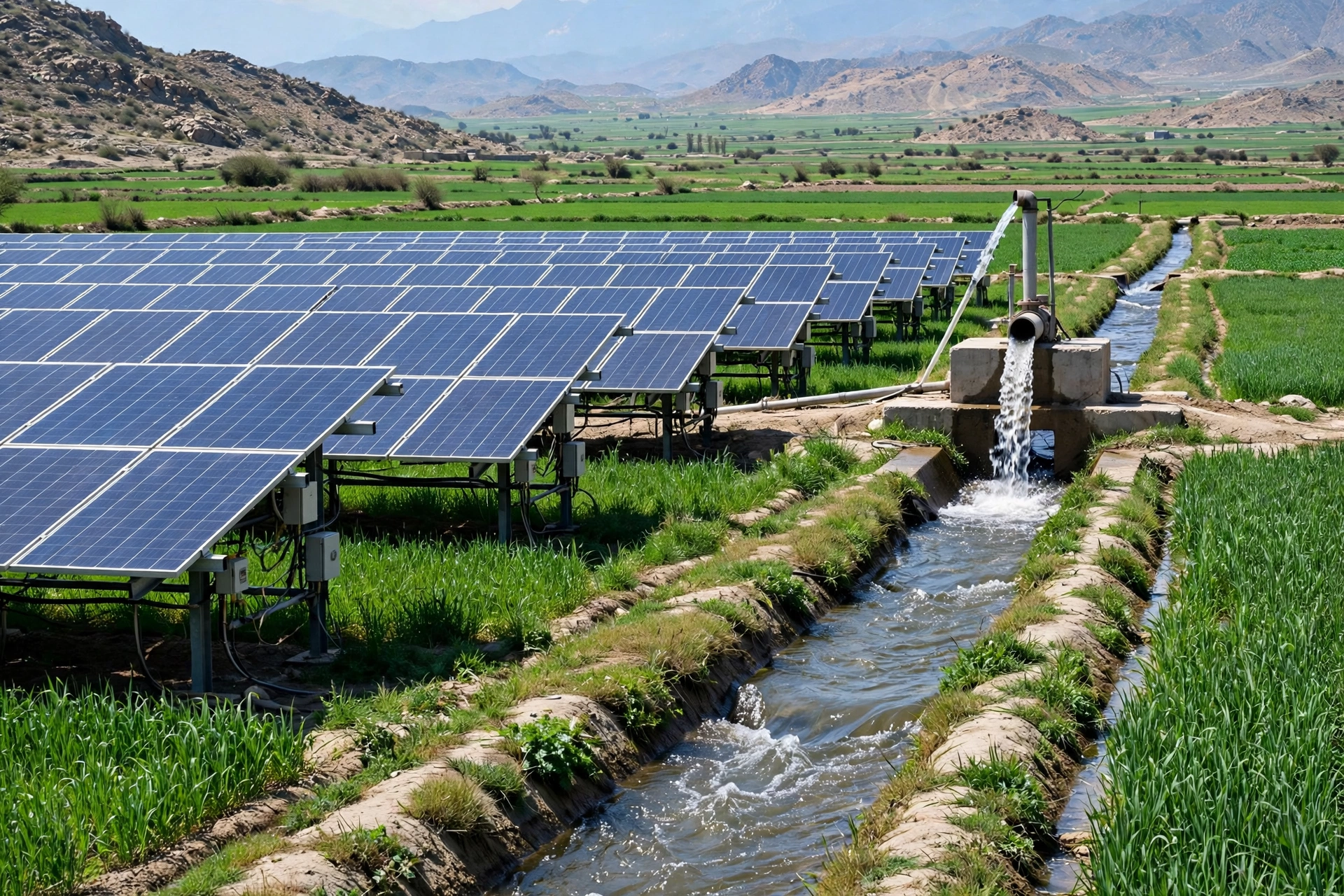
The Balochistan solar tube wells project is converting about 27,000 to 28,000 grid-connected agricultural tube wells in Balochistan to solar power under a plan costing about Rs 55 billion, shared 70 percent by the federal government and 30 percent by the Government of Balochistan. There is no open application form for it: farmers are selected from district lists of grid-connected tube wells, and every converted tube well is disconnected from the grid for good. This guide sits inside our Solar and Energy Schemes hub and our Balochistan Schemes collection, and it explains the cost sharing, the selection method, the disconnection rule and the progress reported so far.
The project was decided by the Prime Minister on 2 July 2024 as a joint federal and provincial programme. The problem it targets is stark: Balochistan’s farmers were receiving only about 2 to 6 hours of grid electricity, which is not enough to run a tube well on any reliable watering schedule. At the same time, the Prime Minister’s office said the old arrangement was costing the federation roughly Rs 80 to 90 billion a year in subsidy against tube well bills that went largely unpaid. Solar conversion is meant to end both problems at once, and a wider national ambition to convert 1 million agricultural tube wells across the country to solar power was also announced alongside it.
| Item | Detail |
|---|---|
| Programme | Balochistan solar tube wells conversion project |
| Decided | 2 July 2024, by the Prime Minister |
| Partners | Federal government and Government of Balochistan |
| Scope | About 27,000 to 28,000 grid-connected agricultural tube wells |
| Total cost | About Rs 55 billion |
| Cost sharing | 70 percent federal government, 30 percent Government of Balochistan |
| Federal releases | Rs 14 billion released first; further releases approved by the ECC in May 2025, with about Rs 24.5 billion more proposed for release |
| Selection | District lists of grid-connected tube wells; no open application |
| Core condition | Converted tube wells are disconnected from the grid and transformers are removed |
| Progress reported | More than 3,000 tube wells solarised by January 2025 |
Balochistan Solar Tube Wells Project Cost and the 70/30 Sharing Formula
The conversion programme carries an estimated cost of about Rs 55 billion. The bill is split between the two governments under a fixed formula: the federal government pays 70 percent and the Government of Balochistan pays 30 percent. That sharing ratio was part of the original July 2024 decision and has stayed at the centre of every later funding step, so the province is a paying partner in the project rather than a passive recipient of a federal scheme.
Funding has moved in stages. Federal releases began with Rs 14 billion, and in May 2025 the Economic Coordination Committee approved further releases to keep the programme moving, with about Rs 24.5 billion more proposed for release at that stage. The staged releases match the way the work itself is organised: tube wells are converted in batches, district by district, and the money follows that rollout instead of being handed over in one block.
How Farmers Are Selected for the Solar Tube Well Conversion
This is the point most farmers get wrong: you cannot apply for this project. There is no application form, no online portal and no registration window. The project works through district lists of grid-connected agricultural tube wells, and conversion is rolled out district by district through the district administration. If your tube well is on the grid and appears in your district’s list, it is converted when your district’s turn comes; if it is not on that list, there is no separate channel to put it there.
This list-based method is deliberate. The project’s purpose is not only to give farmers solar power but also to take specific, known tube wells off the grid permanently, and that can only be tracked against an existing list of connections. Farmers who want to know where their district stands in the rollout should ask through the district administration, which is the office actually carrying out the conversion in each area.
Grid Disconnection Rule: What Happens to Your Old Connection
Every conversion under this project comes with one strict condition: the tube well is disconnected from the grid, and the transformers and fixtures of the old connection are removed. A farmer cannot keep the grid connection as a backup and take the solar system as well. The disconnection is what makes the public money work, because the federation stops paying subsidy on that connection once the well runs on solar.
Compliance is checked, not assumed. The Economic Coordination Committee has directed that implementation be closely monitored, particularly the disconnection of tube wells from the grid and the removal of transformers and fixtures for every batch, and third-party checks are used to stop converted wells from being quietly reconnected. Farmers should treat the conversion as a permanent switch: once your tube well is solarised under this project, the grid connection is gone.
How Many Balochistan Tube Wells Have Been Solarised So Far
Rollout reporting gives a clear early marker. In January 2025, the Federal Energy Minister told the National Assembly that more than 3,000 tube wells had already been solarised under the project. Work has continued district by district since then, funded by the staged federal releases described above, including the further releases the ECC approved in May 2025.
Two cautions belong with any progress figure. First, the announced scope is stated as about 27,000 to 28,000 tube wells, so even a fast early rollout covers only part of the total, and most districts are still waiting their turn. Second, progress is reported in statements and official reviews rather than on a single public dashboard, so the position in your own district is best confirmed with the district administration instead of relying on province-wide numbers in old news reports.
Solar Tube Wells in Balochistan vs Support for Punjab Farmers
Farmers in other provinces are supported through different instruments, and it helps not to confuse them. Punjab’s support runs through a separate route, the Punjab Kissan Card, which a farmer actively obtains and uses, while the Balochistan project is a one-time physical conversion of the tube well itself, delivered to listed wells rather than applied for by individuals. Our Agriculture Schemes hub collects the farm support programmes province by province so you can compare what exists where you farm.
The practical difference is control. A card or loan scheme starts when the farmer applies; this project starts when the district list reaches your area. If you farm in Balochistan with a grid-connected tube well, your task is simply to confirm through the district administration whether your well is on the list and when your district’s batch is scheduled.
Balochistan Solar Tube Wells FAQs
No. The project has no open application process. It works through district lists of grid-connected agricultural tube wells, rolled out district by district through the district administration. If your tube well is grid-connected and on your district’s list, it will be converted when your district’s turn comes. Your district administration is the office to ask about your position.
The two governments pay between them. The total cost is about Rs 55 billion, shared 70 percent by the federal government and 30 percent by the Government of Balochistan. Federal releases began with Rs 14 billion, and the ECC approved further releases in May 2025, with about Rs 24.5 billion more proposed for release.
It is removed. Disconnection from the grid is a core condition of the project: the converted tube well is taken off the grid and the transformers and fixtures are removed. Third-party checks are used to make sure converted wells are not reconnected, so the switch to solar is permanent.
The Federal Energy Minister told the National Assembly in January 2025 that more than 3,000 tube wells had already been solarised. The full announced scope is about 27,000 to 28,000 tube wells, and conversion continues district by district, so most wells are still waiting for their district’s turn.
No, not under this project as announced. The project covers grid-connected agricultural tube wells, because selection is made from district lists of grid connections and the conversion condition is disconnection from the grid. A diesel tube well has no grid connection to convert or disconnect, so it falls outside the project’s stated scope.
Through your district administration. The rollout is organised district by district, and the district administration is the office carrying it out locally. There is no public application portal or online list for this project, so the district office is the reliable source for your area’s schedule.
Keep exploring: Solar and Energy Schemes · Balochistan Schemes · All Government Schemes
Last updated: November 4, 2026