
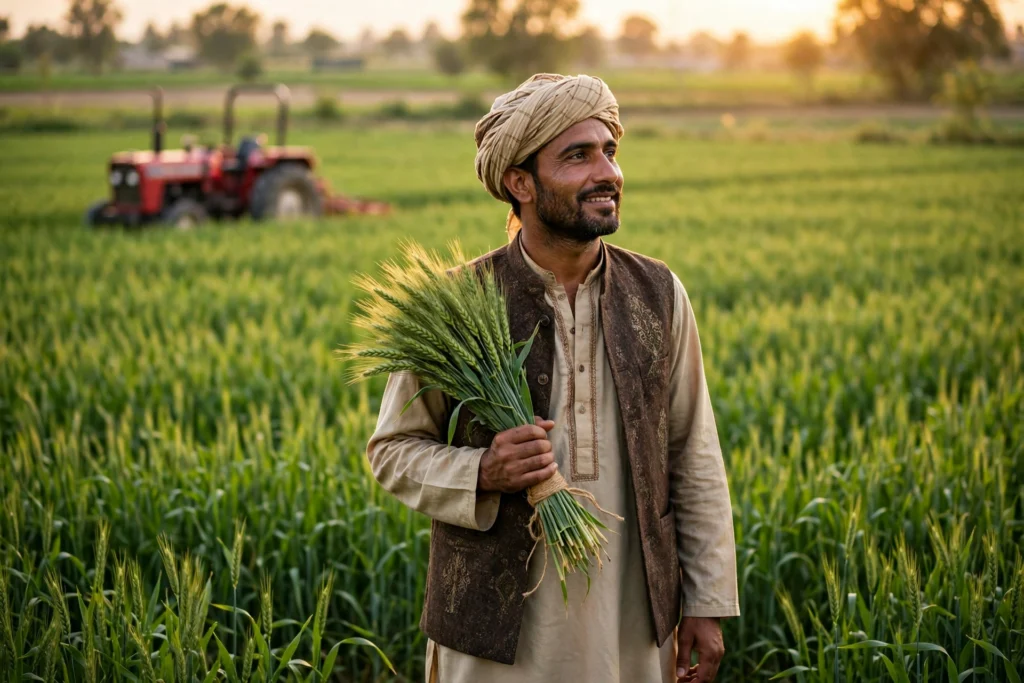
A Pakistani farmer’s year turns on cash arriving before the season does, and the provinces have built very different machines to deliver it. Punjab Kissan Card is credit: an interest-free production loan of up to Rs 360,000 per season, drawn at input dealers and repaid after harvest. Sindh’s Benazir Hari Card is a payment channel: subsidies and seasonal support credited to the farmer’s own Sindh Bank account against verified land records. And Punjab’s Green Tractor Scheme is an asset subsidy: Rs 750,000 to Rs 1 million off a tractor for balloted winners. Credit, subsidy and machinery solve different problems, and applying for the wrong one costs a season. This page separates the three.
The Schemes at a Glance
| Scheme | Type | Amount | Who it serves |
|---|---|---|---|
| Punjab Kissan Card | Interest-free seasonal loan | Up to Rs 360,000 per season (Rs 30,000 per acre) | Punjab farmers with 1 to 25 acres in PLRA records |
| Benazir Hari Card | Subsidy payment channel | Notified packages credited per season | Sindh farmers with 1 to 25 acres, Form-VII verified |
| Green Tractor Scheme | Machinery subsidy | Rs 750,000 (low power) or Rs 1,000,000 (hi power) | Punjab farmers, by digital ballot, minimum land by phase |
Punjab Kissan Card: Credit That Follows the Crop
Register by SMS (PKC, space, your CNIC, to 8070) from a SIM in your own name, and the Bank of Punjab issues a card against your PLRA land record. Phase II lends Rs 30,000 per acre up to Rs 360,000, interest-free, with 30% drawable as cash and the rest spent on seed, fertilizer and pesticide at registered dealers. Repayment falls due after each season; about 900,000 cards were out by July 2026 against a one million target, and the government reports recovery around 99%. Our Kissan Card guide covers defaults, the checks (NADRA, e-CIB) and the per-season cycle.
Benazir Hari Card: Sindh’s Subsidy Channel
Sindh chose grants over credit: the Hari Card is a Sindh Bank debit card for farmers of 1 to 25 acres, verified through Form-VII by the Mukhtiarkar, and support packages land in it as they are notified: DAP support and subsidised urea in the wheat programme, a minister-announced Rs 4,000 per acre DAP rate in the Rabi 2026-27 package inside a Rs 14.9 billion allocation, a Rs 2,000 per maund wheat delivery incentive, calamity relief, even an 80% solar drip-irrigation subsidy window. Our Hari Card guide explains registration and why the land record is everything.
Green Tractor Scheme: The Balloted Subsidy
Punjab’s tractor programme does not queue applicants; it ballots them. Phase IV (low power, 50 to 65 HP) offered 10,000 tractors with a Rs 750,000 subsidy for farmers with at least 5 acres; 213,637 applied and 128,757 survived verification for the 23 September 2026 digital ballot. Phase V (hi power, 75 to 125 HP) raises the subsidy to Rs 1 million with a 7-acre minimum, through gts.punjab.gov.pk, from approved local manufacturers. One tractor per family, and past beneficiaries sit out. Our Green Tractor guide tracks phases and results.
Which Support Matches Your Season?
- Need inputs now and can repay at harvest: Kissan Card (Punjab) is built for exactly that cycle.
- Sindh farmer: keep Hari Card registration, Form-VII and bank account in order; support arrives as packages are notified, not on request.
- Ready to mechanise and can carry the balance cost: watch Green Tractor phases; the ballot decides, so a lost ballot is not a rejection of your farming.
- Cross-check the federal PM Youth Loan’s agriculture window too if you are 21 to 45; our business loans page explains its tiers.
Agriculture Schemes: FAQs
Yes. The Bank of Punjab lends up to Rs 360,000 per season in Phase II (Rs 30,000 per acre) at zero markup, repayable after the season. The card is for farmers with 1 to 25 acres in PLRA records.
Notified subsidies and support, credited to the farmer’s Sindh Bank account: fertilizer assistance (DAP support and subsidised urea in the wheat programme), seasonal packages, a Rs 2,000 per maund wheat delivery incentive and calamity relief.
By digital ballot among verified eligible applicants. In Phase IV, 128,757 verified farmers entered the ballot for 10,000 tractors with a Rs 750,000 subsidy.
No. The Kissan Card is Punjab’s programme against Punjab land records. Sindh’s equivalent channel is the Benazir Hari Card.
At least 5 acres for the low-power phase and 7 acres for the hi-power phase, verified through PLRA and NADRA records.
Registration for the cards and the tractor ballot is free. Pay no agent who promises a card, a subsidy release or a ballot win.
Before you apply, put your papers in order first, because most delays come from records, not eligibility. Check that your PLRA record or Form-VII shows the land you actually farm, that your CNIC details match your bank account, and that any SIM used for registration is in your own name. Keep a copy of each application, ballot result or subsidy notice, and note the season it relates to, so you can compare what was promised with what arrives. If a dealer, bank or office asks for a fee to speed up a free card, subsidy or ballot, treat that as a warning sign and use the official channel instead. Finally, match the support to the timing of your crop: use seasonal credit for inputs, use notified subsidies to lower the cost of fertilizer and other essentials, and treat a tractor as a long term investment that only makes sense when the balance cost, maintenance and fuel fit your farm budget. With those checks in place, the three schemes in this guide become easier to compare, and easier to use without losing a season to the wrong application. Start with the scheme that matches your province, your land record and your season, and keep the other two in view for a later year.
Last updated: November 4, 2026