
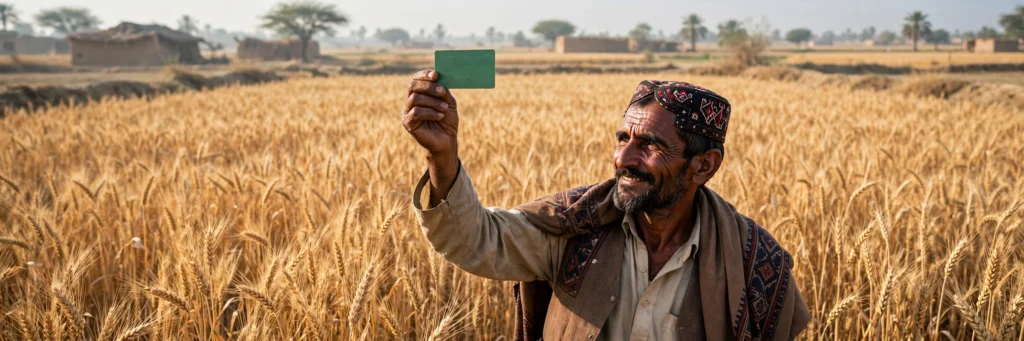
The Benazir Hari Card is the Sindh government’s farmer support card, issued through Sindh Bank to registered farmers who cultivate up to 25 acres. Instead of paying subsidies through middlemen, the Agriculture Department credits support directly to the farmer’s own card account: fertilizer assistance, wheat-season support, help after natural calamities, and other notified benefits, against land records verified from Form-VII. Around 298,000 farmers were covered in the first phase, with registration continuing toward a target of about 1.4 million farmers. This page explains who qualifies, what has actually been paid through the card so far, and how registration works. Punjab’s equivalent delivery card is covered in our Punjab Kissan Card guide.
Quick Facts
| Scheme | Benazir Hari Card (Agriculture Department, Government of Sindh) |
| Issued by | Sindh Bank, as a biometric debit and ATM card linked to the farmer’s account |
| Who | Sindh farmers cultivating 1 to 25 acres, with Form-VII land records |
| First phase | About 298,000 registered farmers; registration target about 1.4 million |
| Support paid | Fertilizer (DAP and urea) assistance, wheat support, calamity relief, notified seasonal packages |
| Land record | Form-VII verified through the local Mukhtiarkar (revenue office) |
| Portal | benazirharicard.gos.pk |
| Fund | Rs 8 billion set aside for the programme at launch briefings |
What Support Comes Through the Hari Card?
The card is a channel, not a single payment: the government notifies a support package, verifies the farmer’s land and crop, and credits the money to the card account. Support delivered or announced through it includes:
- Wheat Financial Assistance: for the 2025 wheat crop, farmers with 1 to 25 acres received per-acre support for DAP fertilizer in the first phase, and, after DAP use was verified, two bags of urea per acre at a subsidised rate of Rs 8,000 (official Agriculture Extension handout).
- Rabi 2026-27 wheat package: a DAP input subsidy (the Agriculture Minister announced a rate of Rs 4,000 per acre) within a Rs 14.9 billion provincial allocation, plus a cabinet-approved incentive of Rs 2,000 per maund for verified farmers delivering wheat to Food Department procurement centres.
- Seasonal and calamity support: subsidies on seed, fertilizer and pesticides, bardana support at procurement, and relief when floods or other calamities damage crops.
- Irrigation support: an 80% government subsidy on solar-powered drip irrigation for holdings of 5 to 25 acres was run under the same farmer-support umbrella (farmer pays 20%).
Amounts are set package by package and season by season; the constant is the channel. If money is announced for Sindh farmers, it is your verified land record and this card that decide whether it reaches you.
Who Can Get a Benazir Hari Card?
- A resident of Sindh who is actively farming.
- Landholding of 1 to 25 acres in your name or under your cultivation, so large landowners are outside the scheme.
- Land records in Form-VII (Deh/Khata), verified by the local Mukhtiarkar.
- A valid CNIC, and a Sindh Bank account opened with biometric verification, linked to the card.
- Not already receiving the same support through another channel for the same crop and season.
Sharecroppers (haris) are the programme’s namesake and its core audience: where the cultivation record supports it, the cultivating farmer, not only the title holder, is the person the support is designed to reach. Your district agriculture office can confirm how your Deh record is treated.
How Registration Works
- Registration runs through the Agriculture Department’s farmer registration drives and district offices; check the official portal benazirharicard.gos.pk for your district’s current window.
- Present your CNIC and land documents; your Form-VII record is verified through the Mukhtiarkar.
- Open your Sindh Bank account with biometric verification; the Hari Card is issued against this account.
- When a support package is notified, eligible farmers are credited after crop and land verification for that season; many farmers receive an SMS when the card or a payment is ready.
- Withdraw or spend from the card like any debit card, and keep your land record and CNIC details current for the next season.
Registration and the card are free. Anyone demanding a fee to register you or to release a subsidy is not part of this programme; report them to the Agriculture Department.
Hari Card or Punjab Kissan Card?
- Benazir Hari Card (Sindh): a payment channel; support arrives as notified subsidies and seasonal packages credited to the farmer’s account.
- Punjab Kissan Card: an interest-free production loan (up to Rs 360,000 per season in Phase II) drawn and repaid each season.
The designs differ: Sindh’s card mainly delivers grants and subsidies, Punjab’s mainly delivers credit. A Sindh farmer’s practical task is keeping registration, land record and bank account in order so each notified package can land.
Benazir Hari Card: FAQs
Farmers in Sindh cultivating 1 to 25 acres with Form-VII land records verified by the Mukhtiarkar, a valid CNIC and a biometric Sindh Bank account. Registration runs through the Agriculture Department.
Notified support packages: fertilizer assistance such as the wheat programme’s DAP support and subsidised urea, seasonal subsidies, wheat delivery incentives, and calamity relief, credited directly to the card account.
For the Rabi 2026-27 wheat package, the Agriculture Minister announced Rs 4,000 per acre for DAP within a Rs 14.9 billion allocation. Rates are set per package, so check your district’s notification for the current season.
No. The card mainly delivers grants and subsidies. It is different from the Punjab Kissan Card, which is an interest-free loan repaid each season.
Through your Sindh Bank account linked to the card, at a branch, ATM or via the bank’s channels; farmers also commonly receive an SMS when payments or cards are ready.
No. Registration, verification and the card are free. Anyone charging a fee is not authorised by the programme.
Before you visit the district office, gather the documents that decide most cases: your CNIC, the Form-VII record for the land you cultivate, and the Sindh Bank account details linked to your card. Check that the name on the land record, the CNIC and the bank account match, and ask the office to correct any mismatch before a new package is announced, because verification for that season usually closes quickly. Keep any SMS about your card or a payment, and keep receipts for fertilizer and seed purchases, since they can help if a payment is delayed or a record is questioned. If a payment does not arrive when other farmers in your Deh have been credited, start with Sindh Bank and then your district agriculture office, and take your card and CNIC with you. Used this way, the Hari Card is less a one-time benefit and more a standing record of your farming, one that should make each future subsidy easier to receive.
Keep exploring: Agriculture Schemes · Sindh Schemes · All Government Schemes
Last updated: November 4, 2026