
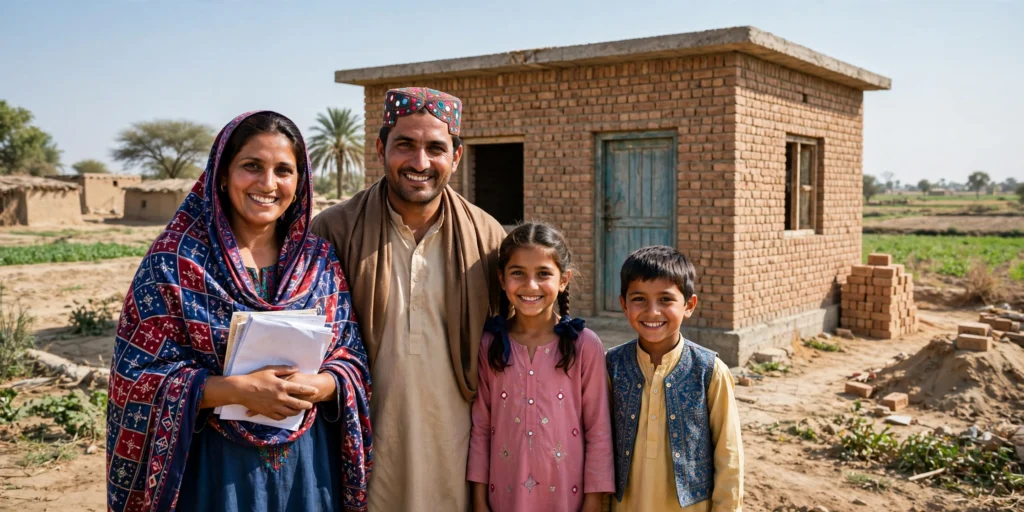
Sindh People’s Housing for Flood Affectees (SPHF) is the Sindh government’s programme to rebuild the homes destroyed in the 2022 floods: a grant of Rs 300,000 for each destroyed house, paid in four tranches into the beneficiary’s own bank account as construction passes verified stages, with a target of 2.1 million houses across 24 districts, the largest flood housing programme in the world. There is no open application for this grant: beneficiaries come from the official damage survey. This page explains how the money actually reaches families, how to check your case by CNIC on the official platform, and who is not covered, because most rumours about SPHF start there. The official platform is sphf.gos.pk.
Quick Facts
| Programme | Sindh People’s Housing for Flood Affectees (SPHF), Government of Sindh |
| Grant | Rs 300,000 per destroyed house, in four tranches; Rs 50,000 reported for eligible partial-damage cases |
| Tranches | Rs 75,000 at start, Rs 100,000 after plinth, Rs 100,000 after walls to lintel, Rs 25,000 on completion |
| Paid to | The beneficiary’s own bank account; no contractors or middlemen |
| Progress (Oct 2026) | About 2 million validations, 1.65 million accounts opened, 1 million houses completed, per the SPHF platform counters |
| Check status | sphf.gos.pk beneficiary platform, by CNIC |
| Complaints | 0800-90090 or complaints@sphf.gos.pk |
| Funding | About $2 billion: World Bank, ADB, Islamic Development Bank, EIB, Sindh and federal governments |
How the Rs 300,000 Reaches a Family
SPHF deliberately pays the family, not a contractor. A bank account is opened in the beneficiary’s own name, and the grant arrives in four tranches tied to construction stages verified by the programme’s partner organisations on site:
| Tranche | Amount | Released when |
|---|---|---|
| First | Rs 75,000 | Construction begins (foundation and plinth stage) |
| Second | Rs 100,000 | Plinth completed and verified |
| Third | Rs 100,000 | Walls raised to lintel level and verified |
| Fourth | Rs 25,000 | Roof and completion verified |
Families build their own core house to SPHF’s multi-hazard resilient design, with technical guidance from partner organisations. Be honest about the maths, as beneficiaries themselves report it: Rs 300,000 covers the core unit the programme designed, and many families add Rs 150,000 to 200,000 of their own money for a larger or finished home. The grant is a foundation to build on, not always the full cost.
Who Is Covered by SPHF, and Who Is Not?
- Covered: households whose homes suffered structural damage in the 2022 floods, recorded in the official damage assessment and verification survey, in the programme’s districts.
- Covered: partially damaged mud (kacha) houses, reclassified for rebuilding support by a Sindh cabinet decision.
- Not covered: homes with only non-structural damage.
- Not covered: houses in high flood-risk locations such as floodplains and stream beds, where rebuilding is unsafe.
- Not covered: partially damaged brick (paka) houses under the current cabinet decision, and families who already rebuilt on their own before the programme reached them.
Land titles are part of the package: more than 800,000 landless rural residents are receiving formal title deeds (Sanads), issued in the names of women heads of household, and beneficiary bank accounts follow the same principle.
How to Check Your SPHF Status by CNIC
- Open the official SPHF website, sphf.gos.pk, and go to the beneficiary status platform.
- Enter your CNIC number and submit.
- The platform shows three things: whether your house qualified in the damage survey, whether your bank account is open, and how far your tranche payments have progressed.
If the platform shows no record but your house was structurally damaged in 2022, your case turns on the survey record: raise it through SPHF’s complaint channels (toll-free 0800-90090, or complaints@sphf.gos.pk) and your district’s partner organisation, with your CNIC and any survey documentation you hold.
No New Registration: The Warning That Matters
SPHF has never run an open public application; it works from its damage survey lists. New donor funding, including the European Investment Bank’s 115 million euro package ratified in October 2026 for the programme’s next phase, flows to already mapped and validated households. Anyone selling SPHF registration, taking money to add a name, or running a look-alike portal is committing fraud. The only official doors are sphf.gos.pk, the helpline 0800-90090 and the programme’s partner organisations in your district.
Sindh People’s Housing (SPHF): FAQs
Rs 300,000 per house, paid in four tranches into the beneficiary’s own bank account: Rs 75,000 at the start, Rs 100,000 after the plinth, Rs 100,000 after walls reach lintel level, and Rs 25,000 on completion.
On the beneficiary platform at sphf.gos.pk, enter your CNIC. It shows your eligibility from the damage survey, your bank account status and your payment progress.
There is no open application. SPHF beneficiaries are selected from the official 2022 flood damage survey and verification lists. If your damaged house was missed, use the complaint helpline 0800-90090 rather than any agent.
Common reasons from the programme’s own rules: the damage was non-structural, the house stands in a high-risk flood zone, a partially damaged brick house falls outside the current cabinet decision, or the family had already rebuilt independently.
No. SPHF pays you the grant in stages and provides resilient designs and technical guidance through partner organisations; your family builds the house, and each next tranche follows on-site verification.
A package of about $2 billion from the World Bank, the Asian Development Bank, the Islamic Development Bank, the European Investment Bank, and the Sindh and federal governments.
For families still waiting, the safest next step is simple: check the official platform by CNIC, keep your CNIC and survey documents together, and use only the helpline and partner organisations for questions. Do not pay anyone who promises faster approval or a place on a list, because SPHF does not work that way. A verified record, an account in your own name, and stage-by-stage verification are what move a case forward, and those checks protect both the grant and the home it is meant to rebuild. If your payments pause, ask first whether a construction stage still needs verification, whether your bank account details are correct, and whether your district partner has recorded the latest stage. Keep copies of survey papers, bank messages, and any helpline reference you receive, and follow up through the same official channels rather than through intermediaries. That patient, documented route is the route SPHF itself uses.
Keep exploring: Housing Schemes · Sindh Schemes · All Government Schemes
Last updated: November 4, 2026