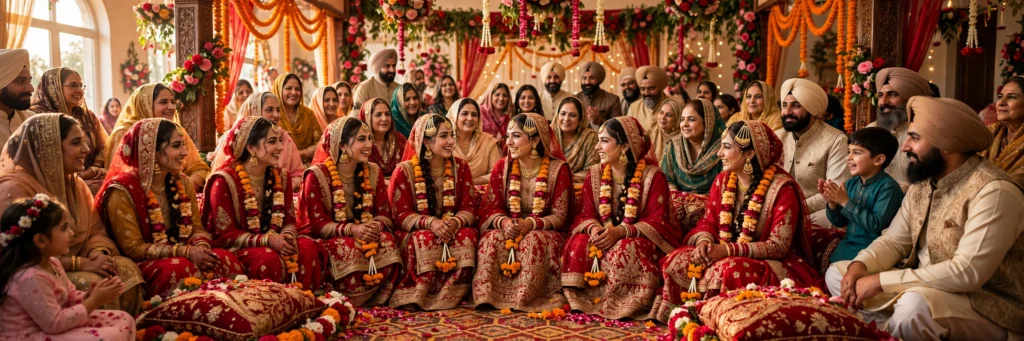
The Punjab Dhee Rani Program, run by the Social Welfare and Bait-ul-Maal Department, arranges dignified collective weddings for daughters whose families cannot afford a marriage: each selected bride receives a cash gift (salami) of Rs 200,000 through a Bank of Punjab ATM card, a dowry package of household essentials worth about Rs 206,000, and a proper wedding ceremony with food for both families, all arranged by the government. Around 5,000 brides are supported a year. This page explains who qualifies, what the bride receives, and how to apply. The department’s other household support, for persons with disabilities, is covered in our Himmat Card guide.
Quick Facts
| Fact | Detail |
|---|---|
| Programme | Punjab Dhee Rani Program (Collective Marriages), Social Welfare and Bait-ul-Maal Department |
| Cash gift | Rs 200,000 salami to the bride, through a Bank of Punjab ATM card |
| Dowry package | Household essentials worth about Rs 206,000 |
| Ceremony | Government-arranged collective wedding, with food for guests |
| Scale | About 5,000 brides a year; programme funding Rs 1.70 billion for 2025-26 |
| Apply | Online at cmp.punjab.gov.pk, or through district Social Welfare offices |
| Helpline | 1312 |
What Each Bride Receives
- A salami of Rs 200,000, paid to the bride herself through a Bank of Punjab ATM card, so the money is in her hands, not an intermediary’s. The salami was raised from Rs 100,000 in the programme’s early phase to the current Rs 200,000.
- A dowry package of household essentials worth about Rs 206,000, including a copy of the Holy Quran, a prayer mat, a double bed with mattress, mirror and furniture items, and a dinner set with kitchen basics.
- A collective wedding ceremony organised by the department, with the Nikah and food arrangements for guests from both families, so the day carries the dignity of any wedding without its debt.
Taken together, the support per bride is worth more than Rs 400,000, and none of it is a loan: nothing is repaid.
Who Can Apply for Dhee Rani?
- The bride is between 18 and 40 years old and unmarried, with an affidavit confirming she is unmarried and willing to marry in the collective ceremony.
- She is destitute, orphaned, a person with disabilities, or the daughter of a person with disabilities. These priority categories are the heart of the programme.
- She is a resident of Punjab with a Punjab domicile.
- A marriage proposal is settled, so the wedding can take place at the ceremony.
Applications are verified against the province’s socio-economic data, and if applications in a round exceed the places available, selection is by transparent electronic balloting. A family that misses one round can apply in the next; rounds run district by district through the year.
How to Apply for the Dhee Rani Program
- Apply online at the official portal cmp.punjab.gov.pk, or ask for help at your district Social Welfare office or its help desk.
- Enter the bride’s CNIC, age, district and family details, and the groom’s basic information for the confirmed proposal.
- Submit the affidavit of unmarried status and consent to the collective ceremony where the portal or office asks for it.
- Your application goes through local verification of the family’s circumstances.
- Selected brides are informed ahead of their district’s ceremony date, receive the dowry package, and the salami is loaded to the bride’s ATM card around the ceremony.
Applying is free. For help at any step, call the Social Welfare helpline, 1312.
Why Collective Weddings?
For a poor family, a daughter’s wedding can mean years of debt taken at the worst rates, or a wedding delayed indefinitely. The Dhee Rani model replaces the individual expense with a shared ceremony: dozens of couples marry in one dignified event, costs per family fall dramatically, and the public ceremony itself removes the stigma that sometimes attaches to assistance. The bride’s own card and package also matter: the support is visibly hers, which families consistently say changes how secure she feels entering her new home.
Punjab Dhee Rani Program: FAQs
Rs 200,000 as salami, paid through a Bank of Punjab ATM card in the bride’s own name, plus a dowry package worth about Rs 206,000 and the collective wedding ceremony itself.
Unmarried women aged 18 to 40 with a Punjab domicile who are destitute, orphaned, persons with disabilities, or daughters of persons with disabilities, with a settled marriage proposal and an affidavit of unmarried status.
Online at cmp.punjab.gov.pk, or with help from your district Social Welfare office. Applying is free. For guidance, call the helpline 1312.
Household essentials worth about Rs 206,000, including the Holy Quran, a prayer mat, a double bed with mattress, furniture items including a mirror, and a dinner set with kitchen basics.
Selection is by transparent electronic balloting after verification, so every verified applicant has an equal chance. Unsuccessful applicants can apply again in the next round.
No. The salami, the dowry package and the ceremony are a gift from the programme. Nothing is repaid.
For families considering an application, the most useful next step is to gather the basic documents early, confirm that the marriage proposal is settled, and speak to the district Social Welfare office if any detail is unclear, because a complete application moves through verification more smoothly than one that needs repeated corrections. Families should also keep the bride’s CNIC and domicile details ready, keep a copy of the affidavit, and note the ceremony date for their district once selection is confirmed, so that travel, guests and household arrangements can be planned without last minute pressure. The programme is designed to remove the financial barrier that has kept many weddings out of reach, and its combination of cash, household goods and a shared ceremony means that a family does not have to choose between dignity and debt. By supporting about 5,000 brides each year, Dhee Rani also gives communities a visible example of collective help, where neighbours, officials and both families gather to celebrate a new household rather than watching a family struggle alone. Anyone who is unsure whether they qualify should still ask, because the priority categories are broad, the application is free, and the helpline 1312 exists to answer exactly these questions.
Keep exploring: Women and Family Schemes · Punjab Schemes · All Government Schemes
Last updated: November 4, 2026.