
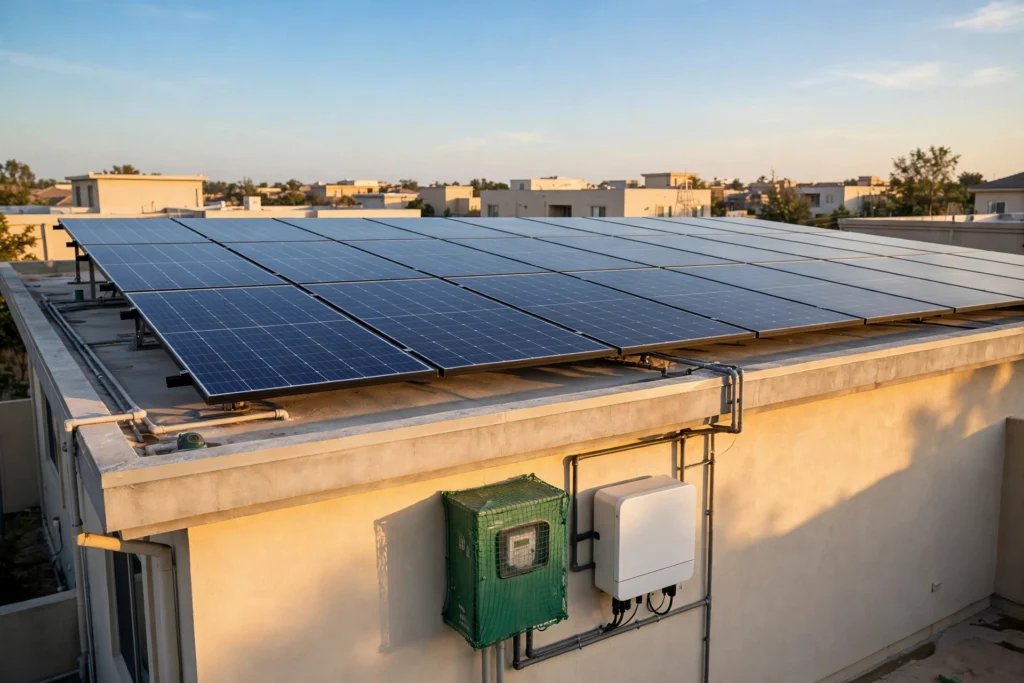
Yes, a household in Pakistan can borrow for rooftop solar at a markup capped at 6% a year, and the route is the State Bank of Pakistan’s Financing Scheme for Renewable Energy, available through ordinary banks and DFIs. This guide sits inside our Solar and Energy Schemes hub and our Federal Schemes collection, and it explains the three loan categories, how the 6% rate is built, who can apply under the household, farm and business category, which documents banks ask for, and how net metering lets you sell your surplus solar power back to the grid.
The scheme was introduced by the State Bank of Pakistan in 2016 and now runs under the revised framework of IH&SMEFD Circular No. 10 of 2019. Its mechanics matter: SBP provides refinance to banks and DFIs at a low rate, the bank adds a capped spread, and the end user pays a maximum markup set by the scheme instead of ordinary commercial rates. Because the money flows through normal bank branches, there is no separate solar loan office and no agent in the middle; you apply at a bank, and the bank decides whether your file is booked under this SBP window or under its own retail product. That single distinction decides what rate you actually pay.
| Item | Detail |
|---|---|
| Scheme | SBP Financing Scheme for Renewable Energy |
| Run by | State Bank of Pakistan, through banks and DFIs |
| Framework | Introduced 2016; revised under IH&SMEFD Circular No. 10 of 2019 |
| End-user markup | Capped at a maximum of 6% per year |
| Household route | Category II: projects up to 1 MW |
| Category II limit | Up to Rs 400 million for a single borrower |
| Category II tenor | Up to 10 years, including a grace period of up to 3 months |
| Refinance | Up to 100% of the financing |
| Net metering | Surplus power can be sold to your DISCO under NEPRA rules |
What Is the SBP Solar Financing Scheme for Renewable Energy
The Financing Scheme for Renewable Energy is a refinance facility: the State Bank lends to banks and development finance institutions at a concessional rate for onward lending to renewable energy borrowers, and in return the banks must keep the end-user markup within the scheme cap. The revised 2019 framework organises borrowers into three categories so that a power project developer, a homeowner, a farmer and a solar vendor company are not forced through the same door. For most readers of this site, the relevant door is Category II, which covers solar installed for your own use, with the option to export surplus electricity to your distribution company under net metering.
Solar Loan Categories: Who Falls Where
Category I is for larger renewable energy projects above 1 MW and up to 50 MW. Financing of up to Rs 6 billion is available for a single project, with a tenor of up to 12 years. Category II covers projects up to 1 MW set up for own use or for supplying surplus power to the DISCO under NEPRA’s net metering rules; a single borrower can take up to Rs 400 million, the tenor runs up to 10 years including a grace period of up to 3 months, and refinance is available up to 100% of the financing. Category III is not for end users at all: it serves certified vendors, suppliers and energy companies in the renewable supply chain.
How the 6 Percent Solar Loan Rate Works
The Category II rate is built in two parts: SBP’s refinance is priced at 2%, and the bank may add a spread of up to 4%, which produces the maximum end-user markup of 6% a year. Read that sentence again before visiting any bank, because banks also sell their own retail solar products alongside this scheme. Products such as Meezan Bank and Bank of Punjab solar financing are commercial offers whose rates can be KIBOR-linked and noticeably different from the 6% SBP window. Neither product is a scam; they are simply different contracts. The reader skill that protects you is to ask the bank, in writing, whether your loan is being booked under the SBP renewable energy scheme, and to get the markup and its fixed or floating nature stated on paper before you sign.
Who Can Apply for a Solar Loan Under Category II
Category II is the household, farm and business route: any borrower installing a renewable system of up to 1 MW for own use qualifies to be considered, whether the panels go on a home, a shop, a school, a small factory or a farm. The same category also covers borrowers who want to sell surplus electricity to their DISCO under net metering, which is how a rooftop system earns back part of its cost after installation. Eligibility for consideration is not a guarantee of approval; the bank still runs its normal credit checks, verifies the property and the electricity connection, and satisfies itself that the system and its installer are genuine.
Documents Required for a Solar Financing Application
Keep four things ready before you apply. First, your CNIC. Second, your latest electricity bill, which proves the connection, the sanctioned load and your consumption history. Third, property ownership proof for the premises, or tenancy proof where you occupy the property as a tenant. Fourth, a system quotation from an AEDB-certified installer, because banks want the equipment, capacity and price specified by a certified vendor rather than an informal estimate. A complete file moves faster than any follow-up promise, and the quotation is also your comparison tool when you take quotes from more than one installer.
How to Apply for Solar Financing: Step by Step
The process runs in a practical order. One, get quotations from AEDB-certified installers for the system size your bill justifies. Two, choose your bank and state clearly that you want financing considered under the SBP renewable energy scheme. Three, submit the application with your CNIC, latest bill, property or tenancy proof and the chosen quotation. Four, the bank surveys the site and verifies the documents. Five, after approval the system is installed. Six, you apply for net metering through your DISCO. Seven, the DISCO process completes and your meter is changed to a bidirectional net metering meter, after which exported units start appearing as credits on your bill.
Net Metering in Pakistan: Selling Your Extra Solar Power
Net metering is the arrangement that lets a solar consumer sell surplus electricity to the grid and draw power back at night, settling the difference on the monthly bill. In practice it needs a three-phase connection, an application through your DISCO, and the generation licence process that applies to distributed generation under NEPRA rules. Small tube-well connections up to 25 kW were reported exempt from the NEPRA generation licence, which removes one layer of paperwork for farmers. Pairing a Category II loan with net metering is the standard combination this scheme was designed around: the loan finances the system at a capped 6%, and net metering shortens the payback every month the panels produce more than the building consumes.
How Much Solar Can You Finance? Sizing a System From Your Bill
Size the system from your bill, not from a salesman’s target. As a working rule, 1 kW of well-sited panels in Pakistan produces roughly 120 to 150 units of electricity a month, depending on your city, the season and shading on your roof. That gives a simple starting estimate: a home using up to 150 units a month looks at about 1 to 2 kW; a home using 150 to 300 units looks at about 3 kW; 300 to 500 units points to about 5 kW; 500 to 800 units points to 7 to 10 kW; and 800 to 1,200 units points to 10 to 15 kW. Treat these as starting estimates only. The installer’s site survey, your roof direction and how much of your usage is in daylight hours decide the final size, and the bank finances the size the certified quotation supports.
SBP Solar Loan vs a Bank’s Own Solar Product
Both products sit in the same bank branch, which is exactly why they get confused. The differences that matter are these:
| Point | SBP renewable energy scheme | Bank’s own retail solar product |
|---|---|---|
| Markup | Capped at a maximum of 6% a year | Set by the bank, often KIBOR-linked and higher |
| Money behind it | SBP refinance to the bank | The bank’s own funds |
| Tenor | Up to 10 years in Category II | Often 3 to 7 years, varies by bank |
| How to identify it | Your file is booked under the SBP scheme, stated in writing | Sold under the bank’s own product name |
Neither product is automatically better for every borrower, because approval speed, processing and the installers a bank works with also matter. But the markup difference over a 10-year loan is large, so the comparison is worth ten minutes before you sign anything.
Why Solar Loan Applications Get Rejected
Most rejections come from the file, not from the scheme. The common reasons are a poor credit history in the e-CIB record, an electricity bill that is not in the applicant’s name, a property that is disputed or rented without the owner’s written consent, a quotation from an installer who is not AEDB-certified, and income that the bank cannot document. Every one of these can be fixed before applying: clear or explain old defaults, transfer the bill or add the owner’s consent letter, use a certified installer’s quotation, and keep salary slips or business records ready. A complete, consistent file is the difference between the 6% window and a polite refusal.
Islamic Solar Financing Under the Same Scheme
The SBP renewable energy framework also runs through Islamic banking windows, so a borrower who wants Shariah-compliant financing is not pushed into a conventional loan. Islamic banks participate with structures approved by their Shariah boards, and the same markup cap logic applies to the profit rate the customer pays. Meezan Bank’s solar financing, mentioned above, is the best known retail example of the Islamic route. When you apply, state at the counter that you want the Islamic window and the SBP scheme, and get both facts recorded on your application.
Solar Financing Scheme FAQs
Under Category II of the SBP Financing Scheme for Renewable Energy, the end-user markup is capped at a maximum of 6% per year. The rate is built from SBP refinance at 2% plus a bank spread of up to 4%.
Category II covers projects up to 1 MW and allows up to Rs 400 million for a single borrower, with a tenor of up to 10 years including a grace period of up to 3 months. A normal home system sits far below that ceiling; the bank finances the quoted cost of your system after its own checks.
Households, farmers and businesses installing renewable systems up to 1 MW for their own use, including those who plan to sell surplus power to their DISCO under net metering. Larger projects fall under Category I, and certified vendors and suppliers fall under Category III.
Yes. Category II expressly covers borrowers supplying surplus power to the DISCO under NEPRA net metering rules. You will need a three-phase connection, an application through your DISCO and the generation licence process; small tube-well connections up to 25 kW were reported exempt from the generation licence.
Banks and DFIs lend under the SBP scheme, and many banks also market their own retail solar products, for example Meezan Bank and Bank of Punjab solar financing. Retail products can carry KIBOR-linked rates that differ from the 6% scheme cap.
No. The 6% cap applies to loans booked under the SBP renewable energy scheme. A bank’s own retail solar product may be priced differently. Ask the bank in writing whether your loan is under the SBP scheme before signing.
Keep exploring: Solar and Energy Schemes · Federal Schemes · All Government Schemes
Last updated: November 4, 2026