
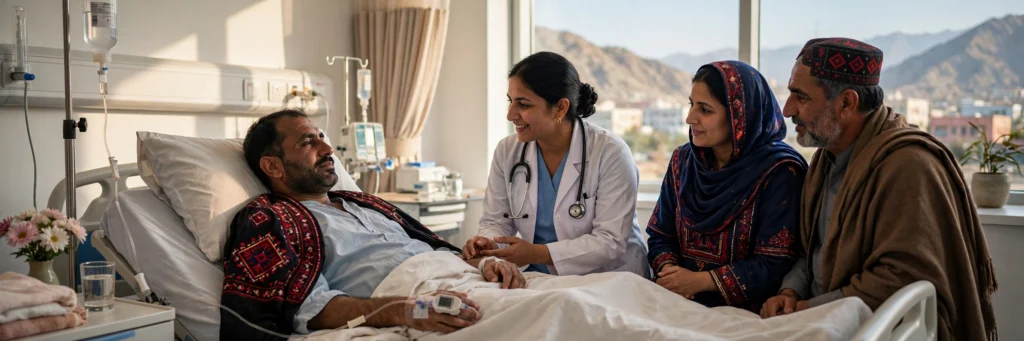
The Balochistan Awami Endowment Fund (BAEF) is the Balochistan government’s fund of last resort for medical catastrophe: when a poor patient needs cancer treatment, open heart surgery, a liver or kidney transplant, or long thalassemia care that no ordinary income can carry, the Social Welfare Department’s fund pays for treatment at leading public and private hospitals across Pakistan. This is not an insurance card; each case is examined and approved on merit by the fund’s board. The scale is real: by February 2025 the province reported Rs 5.13 billion spent on 3,397 patients, and in August 2025 the fund was expanded with a Rs 7 billion allocation, supporting around Rs 90 million of treatment cases a month. For a single transplant patient, spending can reach Rs 20 to 30 million.
Quick Facts
| Fund | Balochistan Awami Endowment Fund (BAEF), Social Welfare Department, Balochistan |
| Purpose | Free treatment of major, expensive diseases for poor and deserving patients |
| Covers | Cancer, open heart surgery, thalassemia, liver transplant, kidney transplant, bone marrow transplant, neurosurgery and other approved chronic conditions |
| Where | Approved hospitals nationwide: Bolan Medical Complex and Cenar Hospital Quetta, Aga Khan and others in Karachi, Shaukat Khanum Lahore, Shifa Islamabad, Gambat and more |
| How decided | Case by case, by the fund’s board, after medical scrutiny and document verification |
| Scale | Rs 5.13 billion spent on 3,397 patients by Feb 2025; expanded with Rs 7 billion in 2025 |
| Apply | Through the Social Welfare Department and district social welfare offices; there is no online portal |
| Cost to patient | The fund pays the hospital for approved treatment; it is a grant, not a loan |
Which Diseases Does BAEF Cover?
- Cancer, including treatment at specialised centres such as Shaukat Khanum and Kiran Hospital.
- Open heart surgery and other major cardiac treatment.
- Thalassemia, including its long, recurring treatment burden.
- Liver and kidney transplants, and bone marrow transplant.
- Neurosurgery and other chronic, high-cost conditions the board approves case by case.
The common thread is cost beyond a poor family’s reach combined with treatment that genuinely exists: the board’s medical scrutiny checks the diagnosis, the treating hospital’s plan and its estimate before approval.
How Are Cases Approved?
- A case file is prepared: patient CNIC, medical reports and diagnosis, and the treating hospital’s treatment plan and cost estimate.
- Files reach the fund through the Social Welfare Department and district social welfare offices; hospitals also refer deserving patients into the process.
- A medical board scrutinises the case, and documents are verified, to keep the fund merit-based and transparent.
- The BAEF board approves cases in its meetings; a single meeting has approved more than 500 patients at a time when funds allowed.
- Payment is arranged with the treating hospital, in Balochistan or in Karachi, Lahore, Islamabad or wherever the treatment is available.
- A special team of doctors follows up at hospitals to confirm patients are actually receiving the approved treatment.
Because approval is by board and budget cycle, timing varies: money released in tranches through the year means genuine cases sometimes wait for the next meeting. Urgency and completeness of documents are what a family can control.
How to Apply for BAEF Assistance
- Gather the medical file first: confirmed diagnosis, doctor’s reports, and a written treatment plan with a cost estimate from the hospital where treatment is possible.
- Visit your district Social Welfare office, or the Social Welfare Department in Quetta, and submit the case with the patient’s CNIC and proof of financial circumstances.
- If a hospital’s own social welfare or zakat desk is already helping you, ask them to route the case as well; many cases enter through treating hospitals.
- Follow up through the same office; board meetings decide in batches, and you will be informed when your case is approved and the hospital is engaged.
There is no online application and no agent in this process. Anyone charging a fee to “get a case approved” is exploiting you; the department’s offices are the only route.
BAEF or the Balochistan Health Card?
- Balochistan Health Card: universal insurance for residents (check by SMS to 8500), paying hospital admission bills up to its annual limit.
- BAEF (this page): a case-approved fund with no small annual cap per patient, designed for the catastrophic treatments, especially transplants and cancer care, whose cost runs into crores.
Use the health card for ordinary admissions; when a diagnosis lands in transplant or long cancer territory, a BAEF case is the route built for it.
Balochistan Awami Endowment Fund: FAQs
A Balochistan government fund, run by the Social Welfare Department, that pays for expensive treatment of major diseases for poor patients at approved hospitals across Pakistan, decided case by case by its board.
Cancer, open heart surgery, thalassemia, liver and kidney transplants, bone marrow transplant, neurosurgery and other approved high-cost chronic conditions.
There is no small fixed cap; the fund pays the approved treatment’s cost at the treating hospital. For transplants, reported spending on a single patient has reached Rs 20 to 30 million.
Prepare the medical file (diagnosis, reports, hospital treatment plan and cost estimate) and submit the case through your district Social Welfare office or the Social Welfare Department. There is no online portal and no fee.
Yes. Approved patients are treated at leading hospitals nationwide, including Aga Khan and Kiran in Karachi, Shaukat Khanum in Lahore, Shifa in Islamabad and Gambat, as well as Bolan Medical Complex and Cenar Hospital in Quetta.
No. It is a grant from the fund for approved treatment, paid for the patient’s care. Nothing is repaid by the family.
Families facing a major diagnosis should start the file early, keep every report and estimate in one place, and stay in regular contact with their district office. A complete file moves faster through medical scrutiny, and a hospital plan that is clear about costs helps the board decide without asking for more papers. BAEF exists for exactly this moment, when treatment is urgent, expensive and otherwise out of reach, so use the official route promptly and do not pay anyone who promises approval.
Keep exploring: Health Schemes · Balochistan Schemes · All Government Schemes
Last updated: November 4, 2026