The Himmat Card is the Punjab Government’s quarterly cash support for persons with disabilities who cannot work to earn a living: Rs 10,500 every three months, paid through a Bank of Punjab card issued by the Social Welfare and Bait-ul-Maal Department. There is no application form for this card, and that confuses many families. Himmat Card beneficiaries are shortlisted automatically from the province’s disability database, DPMIS, so the real task is making sure the disabled person’s record there is complete and correct. This page explains the six eligibility conditions, the registration steps that actually matter, and how to check a name on the official verification page. Note that Himmat Card is separate from BISP: by rule, the two cannot be held together.
| Fact | Detail |
|---|---|
| Scheme | CM Punjab Himmat Card (Social Welfare and Bait-ul-Maal Department) |
| Stipend | Rs 10,500 per quarter (about Rs 3,500 a month, Rs 42,000 a year) |
| For | Certified persons with disabilities in Punjab, assessed as not fit to work |
| Card | Bank of Punjab ATM card, issued free |
| Application form | None: beneficiaries are shortlisted from the DPMIS database |
| Status check | dpmis.punjab.gov.pk Himmat Card verification page, by the beneficiary’s own CNIC |
| Helpline | Social Welfare helpline 1312 |
| Beneficiaries | Around 85,000 eligible persons targeted |
Who Qualifies for the Himmat Card?
All six conditions must hold at the same time:
- The person’s CNIC (or B-Form, for a child registered by a parent or guardian) is registered in Punjab.
- They hold a disability certificate issued by Social Welfare Punjab after assessment.
- The district disability assessment board has assessed them as “not fit to work”. This is the board’s decision, not the family’s view.
- They are not employed in any government or private job.
- They are not currently receiving support from BISP, PSPA, Zakat or Bait-ul-Maal.
- The household PMT score is 45 or less, from the BISP survey database.
The PMT limit and the no-other-support rule are where most hopes fail. If a family member’s BISP payment covers the household, the disabled person is not separately shortlisted for Himmat Card; the programmes are designed to spread support across different families rather than stack it.
How to Get Registered: The Steps That Matter
- Register the disabled person on the DPMIS portal, dpmis.punjab.gov.pk, using the Register option with their CNIC or B-Form. District Social Welfare offices help families who cannot do this online.
- Attend the district disability assessment board when called. The board records the disability type and decides fitness for work.
- Receive the Social Welfare disability certificate, and where issued, the special NADRA CNIC carrying the disability logo.
- Keep the DPMIS record updated: CNIC details, address, mobile number, education and any work experience. Shortlisting runs on this data, so a stale mobile number or address can silently drop a person.
- The department shortlists eligible persons from DPMIS and issues the Bank of Punjab Himmat Card to them.
There is no deadline pressure in this process: registration and assessment run continuously. What matters is completeness, not speed.
How to Check Your Himmat Card Status
- Open the DPMIS Himmat Card verification page at dpmis.punjab.gov.pk.
- Enter the 13-digit CNIC of the disabled person, not the guardian’s CNIC: this single detail is the most common reason a check wrongly shows nothing.
- The result shows whether the person is on the beneficiary list.
If the person meets all six conditions but does not appear, the fix is almost always in the record: re-check the DPMIS profile for a wrong CNIC digit, an outdated assessment, or an expired certificate, and visit the district Social Welfare office or call the helpline, 1312, to correct it.
Receiving and Using the Stipend
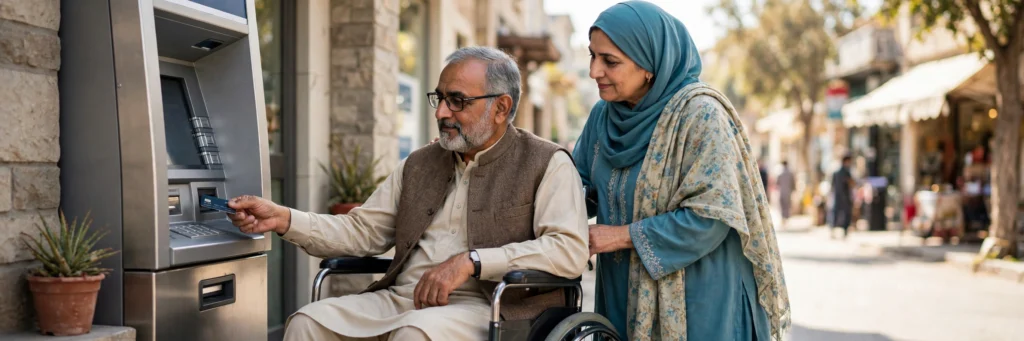
The stipend of Rs 10,500 lands on the card every quarter and can be withdrawn at Bank of Punjab ATMs like any debit card. Guard the card and PIN as you would any bank card: the department never sends agents to collect charges, renew cards for a fee, or ask for your PIN. Report a lost card to the Bank of Punjab and the Social Welfare helpline so the stipend is not diverted.
Himmat Card: FAQs
Rs 10,500 every quarter, which is about Rs 3,500 a month or Rs 42,000 a year, paid through a Bank of Punjab card. The figure is confirmed on the Social Welfare Department’s own pages.
There is no separate application form. Register the disabled person on DPMIS (dpmis.punjab.gov.pk), complete the disability board assessment and certificate, and keep the record updated. Eligible persons are shortlisted automatically.
No. The rules exclude anyone currently receiving support from BISP, PSPA, Zakat or Bait-ul-Maal. The household PMT score must also be 45 or below.
On the DPMIS Himmat Card verification page, enter the disabled person’s own 13-digit CNIC. Using a guardian’s CNIC is the most common reason a check shows nothing.
It is the assessment of the district disability board, recorded during certification: the person is judged unable to earn a living due to disability. The card targets exactly this group.
No. Registration, assessment and shortlisting run continuously through DPMIS and district Social Welfare offices. For help, call the Social Welfare helpline 1312.
Families who keep the DPMIS record accurate give the disabled person the best chance of being shortlisted without delay. Check the certificate, confirm the mobile number on file, and save the helpline number 1312 for questions about assessment or card delivery. If a card is lost or a payment does not arrive, contact the Bank of Punjab and Social Welfare promptly rather than paying anyone who offers to fix the record for a fee. Keep copies of the certificate and CNIC ready when you visit the office. With the right record in place, the quarterly stipend can provide steady help for transport, medicine and daily needs, and that support is the purpose of the Himmat Card for the household.
Keep exploring: Financial Assistance Schemes · Punjab Schemes · All Government Schemes
Last updated: November 4, 2026.